Delirium
Not Without HopeDelirium is the hypothermia- and dehydration-induced breakdown of perception, speech, judgment, and behavior that overtook the four boaters in succession after the capsizing of Marquis Cooper’s 21-foot Everglades boat. In the narrative, it is both a medical progression and a tragic interpretive problem: from the outside, the men seem to abandon one another or behave inexplicably, but the later medical explanation establishes that their minds were being damaged by cold, dehydration, and the physiological consequences of swallowing seawater. The state turns survival behavior into something frighteningly unfamiliar, then forces Nick Schuyler to recognize that the same dissolution is approaching him.
Definition and Physiological Conditions
Delirium develops within a chain of extreme bodily stresses rather than as an isolated mental event. If the boaters had been thrown directly into the Gulf, swallowing large quantities of seawater could have produced a dangerous sodium imbalance, drawing water out of cells and progressing to delirium, seizures, cardiac arrest, and death from dehydration. Cold exposure created a second pathway toward mental failure. As body temperature fell below 95 degrees, blood vessels in the limbs constricted to preserve heat for the heart, lungs, and brain; shivering could advance into clumsy hands, shallow breathing, blue lips, confusion, slurred speech, and irrational or confrontational behavior.
The men’s physical condition made the danger particularly severe. At roughly 65 degrees, an average twenty-five-year-old man might remain functional for 9.9 hours and survive for 15 hours, while a fifty-year-old man might remain functional for 11.6 hours and survive for 17.6 hours. Greater fitness offered no simple protection. Younger, more muscular bodies could have less insulating fat and less flotation, requiring harder effort to remain above water. The book therefore presents delirium as the result of interacting variables—cold water, salt ingestion, repeated exertion, inadequate flotation, hunger, and sleep deprivation—rather than as evidence that the men lacked courage or will.
Progression Among the Boaters
Marquis Cooper is the first of the men whose deterioration becomes unmistakable. After taking in substantial salt water and gagging repeatedly, he began to dry-heave, slur, and ramble; his teeth chattered continuously. His responses to calls of “Coop?” grew slower, changing from immediate answers to delayed replies after his name had been shouted four or five times, sometimes requiring a shake against the hull. The symptoms marked a loss of connection with the people trying to keep him conscious, even before his behavior became fully unintelligible.
Corey Smith followed a similar course. Around five on Sunday morning, he floated at the back of the boat, rambling and making moaning sounds, and failed to answer until Nick Schuyler and Will Bleakley had called his name repeatedly. Then a sudden burst of desperate energy drove him to pull at Marquis’s legs and grab for anything that might lift him onto the hull. His face appeared angry and mean, and he made repeated attempts lasting ten or fifteen seconds before going limp and trying again. Nick understood that this was not the ordinary Corey Smith, whom he knew as kind and easy to get along with, but a person whose thinking had been overtaken by cold after approximately twelve hours in the water.
Will Bleakley’s decline was quieter but no less dangerous. After climbing back onto the boat, he began mumbling and speaking in a deeper tone; Nick could not make out his words, which seemed slurred, reversed, or formed without properly opening his lips. Unlike Corey Smith, he showed no aggression, but his inability to speak clearly revealed the same mental disruption. His physical weakness also made him difficult to keep aboard. When he slipped into the water, his life jacket did not keep him sufficiently above the breaking waves, and Nick had to swim after him despite exhaustion.
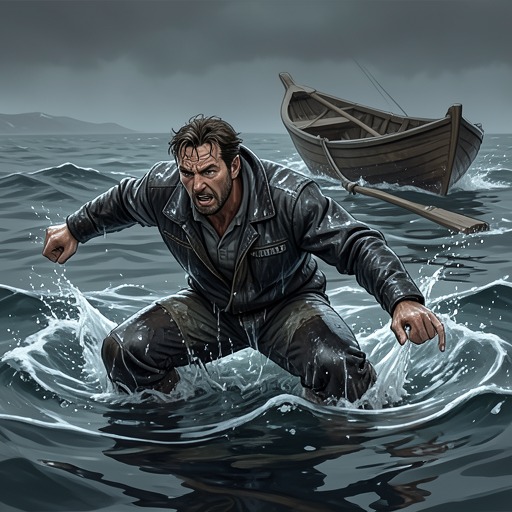
The life jackets themselves provided only limited flotation. Will Bleakley weighed 230 pounds and Nick Schuyler 240, so their efforts to pull Will back to the boat repeatedly sent both men underwater. Will gagged, coughed, and began taking in salt water, reproducing the symptoms Nick had already witnessed in Marquis Cooper. Later, in six- to eight-foot waves, Will slouched over with his head floating in the water and his arms extended almost like those of a figure unable to control itself. He became unresponsive, and the steering cable repeatedly came loose from his wrist; three or four times he went under before Nick could grab him and lift his head. The physical scene makes delirium inseparable from practical danger: once awareness and motor control failed, the water could finish what the cold had begun.
Nick Schuyler’s Recognition and Hallucinations
Nick’s awareness of delirium becomes central because he has watched it happen to the others. At sunrise on Monday, March 2, after the waves had eased somewhat, he was in and out of consciousness, resting his head on his hands at the motor. He heard someone yelling and realized that the voice was his own. In a hallucination, Marquis Cooper, Corey Smith, and Will Bleakley appeared about ten feet behind him under the canopy, seemingly standing on a right-side-up portion of the boat and driving it while Nick remained on the overturned side.
The imagined men appeared to withhold water from him. Nick shouted for a gallon, then saw a clear plastic jug that seemed about to be handed over, only for the others to keep it from him. The hallucination translated his physical deprivation into an interpersonal scene of anger and refusal: thirst became a taunt, and absent friends became figures who appeared to ignore him deliberately. When Nick suddenly became fully alert, he realized with terror that he was losing control of his mind exactly as Marquis Cooper, Corey Smith, and Will Bleakley had done.
That recognition gives the episode its decisive reversal. Nick understood that the others had not simply gone away, given up, or chosen to leave him. Their minds had been damaged by dehydration and hypothermia, and the same process was now beginning in him. He feared that this was the first stage of drifting away, when the mind shut down, and he forced himself to remain awake through small exercises. He also understood that waiting passively would not solve the danger: the elements might not kill him immediately, but dehydration or starvation could, so he concluded that he had to enter the space beneath the overturned boat to search for food or drink.
Medical Meaning and Aftermath
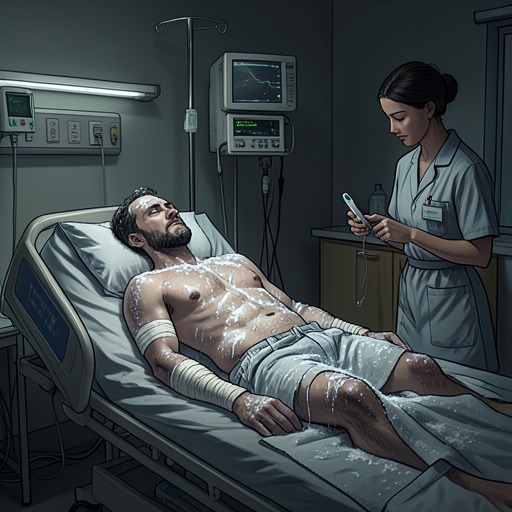
When the Coast Guard recovered Nick, the clinical evidence confirmed how close the process had come to physical collapse. His temperature was 89.5 degrees, far below the normal 98.6, and he had labored breathing, blue lips, cool clammy skin, leg pain, and the early signs of shock. He was mostly coherent and knew his name, location, and the month, but he could not remember who the president of the United States was at that moment. The gap between apparent lucidity and neurological impairment shows that delirium did not necessarily erase every piece of knowledge at once; it disrupted access to knowledge unpredictably.
Nick later reported that hypothermia had set in, that Corey Smith had removed his life jacket, and that Corey’s eyes had looked wrong before he sank. He also described Will Bleakley as possibly having seen a light on the horizon. These details helped transform the men’s last actions from moral mysteries into symptoms of a shared physiological crisis. Medical testimony explicitly rejected the idea that Marquis Cooper, Corey Smith, and Will Bleakley had simply given up. Hypothermia could cause delirium, falling potassium levels, and damage to the heart’s cell membranes until the heart could no longer contract.
The explanation also altered the meaning of Nick’s survivor’s guilt. Dr. Mark Rumbak argued that the men were confused and slipped away as their brains were affected by cold; even tying them to the boat would probably not have saved them, because their hearts might have stopped before rescuers arrived. Their deaths were therefore not the consequence of Nick choosing himself over them. Delirium becomes the book’s crucial corrective to hindsight: it shows why the men’s behavior could not be judged as rational choice and why Nick’s survival, however tormenting, was not an act that caused their deaths.
Narrative and Thematic Significance
The state produces a repeated pattern that governs the disaster’s emotional structure: speech becomes slurred, responses become delayed, bodies lose coordination, behavior turns strange, and consciousness recedes. The repetition allows Nick to identify the pattern in himself, but it also makes each recurrence more devastating. Every new victim is both an individual friend and a confirmation of what the cold is doing to the group.
Delirium also exposes the limits of witness. Nick can describe the external signs—the mumbling, aggression, limpness, hallucinated figures, and unresponsive body—but he cannot fully enter the altered minds of the others. His own hallucination supplies the closest parallel, allowing him to understand retrospectively that Marquis Cooper, Corey Smith, and Will Bleakley were not morally abandoning him. The book’s movement from frightening observation to medical interpretation thus becomes an act of testimony: it preserves the men’s character against the misleading appearance of their final behavior.
Ultimately, delirium is the threshold between endurance and disappearance. The men continue to fight physically even while their minds are failing, and Nick’s last clear struggle is not merely to remain warm or afloat but to remain capable of recognizing reality. His survival depends in part on that recognition—on identifying the hallucination as a symptom and acting before the same process carries him beyond purposeful action. In this way, delirium names both a bodily condition and the disaster’s central tragedy: the men are lost not because their bonds cease to matter, but because hypothermia and dehydration make those bonds increasingly difficult for their minds to perceive or sustain.